
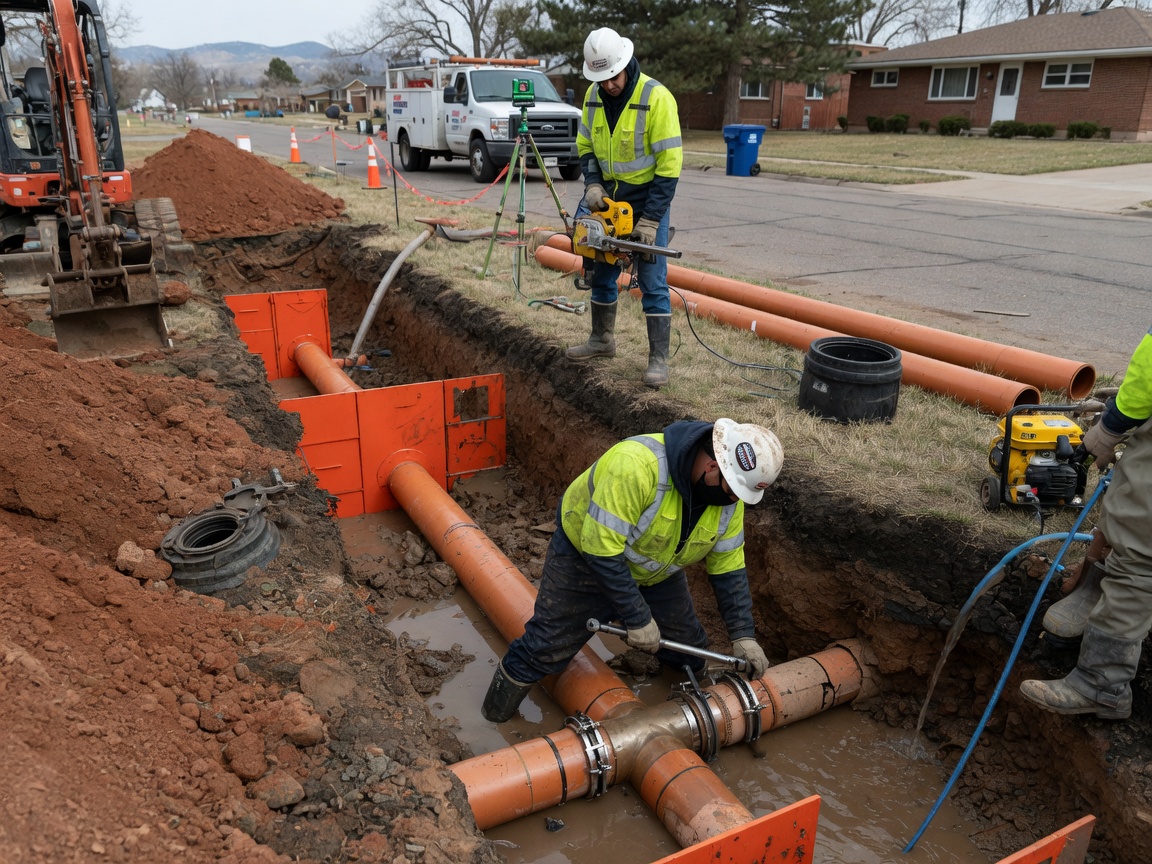
Your sewer line carries everything from the house to the municipal main or septic system, and when it fails the effects are unpleasant and sometimes expensive. Sewer line repair begins with finding out exactly what is wrong: a blockage, a crack, a collapsed section, a joint offset or roots growing through the pipe.
Watch for repeated main line clogs, multiple drains slowing together, gurgling toilets, sewage odors in the yard or basement, damp or unusually green patches over the lateral, and sewage backing into a floor drain or shower. Any of these can point to a problem that cleaning alone will not solve, particularly if it returns within weeks.
Local conditions matter. Older Fort Collins neighborhoods, including areas near Old Town and CSU, often have clay or cast iron laterals that are decades old. Clay joints let roots in, and cast iron corrodes from the inside. Expansive clay soils along the Front Range swell and shrink with moisture, which can pull joints apart or create sags where waste collects. Spring thaw and irrigation season often expose weaknesses that were hiding all winter.
We use a camera inspection, also called a sewer scope, to see the pipe interior and locate the problem. We record where the defect sits and how deep it is, then explain what we saw. Depending on the damage, the options include spot repair, lining or full replacement of the affected section. We discuss each one, along with access, excavation and surface restoration, before any digging begins and we put the scope in writing.
If you suspect a sewer problem, limit water use. Avoid running the dishwasher or washer, and keep toilet flushes to a minimum while you wait. Know where your cleanout is and clear the area around it. If sewage is already backing up, call us, and keep children and pets away from the affected area. If you rent or manage the property, tell the owner or manager right away so the line can be inspected before the problem spreads to other units.
When a repair is needed, the method depends on what the camera shows. A short cracked section may be repaired directly, while a long run of failing clay or cast iron may be better served by lining or replacing the lateral. Each approach has different effects on your yard, driveway and landscaping, and we talk through those effects in advance. We also check where the cleanout sits and whether adding one would make future inspections easier. After any repair, we run water through the line to confirm it flows freely and that the connections hold.
Camera inspections are also worth considering when buying an older home, or before a landscaping project near the lateral. Knowing the condition of the line is easier than discovering it after a backup.
Technician insight
Spring is when many sewer problems announce themselves in northern Colorado: ground thaws, roots wake up, and irrigation starts putting more water in the soil around the lateral. We see a lot of clay laterals with root-filled joints and cast iron with heavy scale in neighborhoods from Old Town outward. The camera frequently reveals a low spot that explains years of unexplained clogs.
Sewer Line Repair Services We Offer
✓Sewer Camera Inspection
A video look inside the lateral to find roots, cracks, offsets and low spots.
✓Sewer Line Repair
Targeted repair of damaged sections when the rest of the pipe is in sound shape.
✓Sewer Line Replacement
Full replacement of failed laterals, including old clay and cast iron.
✓Root Intrusion Clearing
Cutting roots out of the pipe and assessing the damage that let them in.
✓Cleanout Installation
Adding accessible cleanouts so future clearing and inspections are easier.
How it works
- 1
Scope the line
We feed a camera through the cleanout to see the pipe and mark the location and depth of any defect.
- 2
Review what we found
We show you the footage and explain whether the problem is a blockage, a crack, a belly or a collapse.
- 3
Agree the repair plan
We lay out repair options, the access needed and restoration, and put the work in writing.
- 4
Repair and verify
We complete the repair, flow test the line and, where appropriate, run the camera again to confirm.
Pricing
Cost depends on the length and depth of the line, the type of damage, whether repair can be done in sections or the full lateral needs replacing, ground and surface conditions, and restoration needs. The camera inspection tells us what is happening so we can explain the scope before any work starts.